Pelvic Floor Condition
Fecal incontinence — sometimes called accidental bowel leakage — is the loss of control over bowel movements or gas. It is one of the most isolating conditions in medicine, and one of the most under-discussed. Patients often tell me they have not mentioned it to a single other person, including their own physician.
It is also one of the most responsive to specialized care. Roughly one in three adults will experience some degree of fecal incontinence in their lifetime, and the vast majority improve significantly — many to full continence — once they are evaluated by someone who treats this routinely.
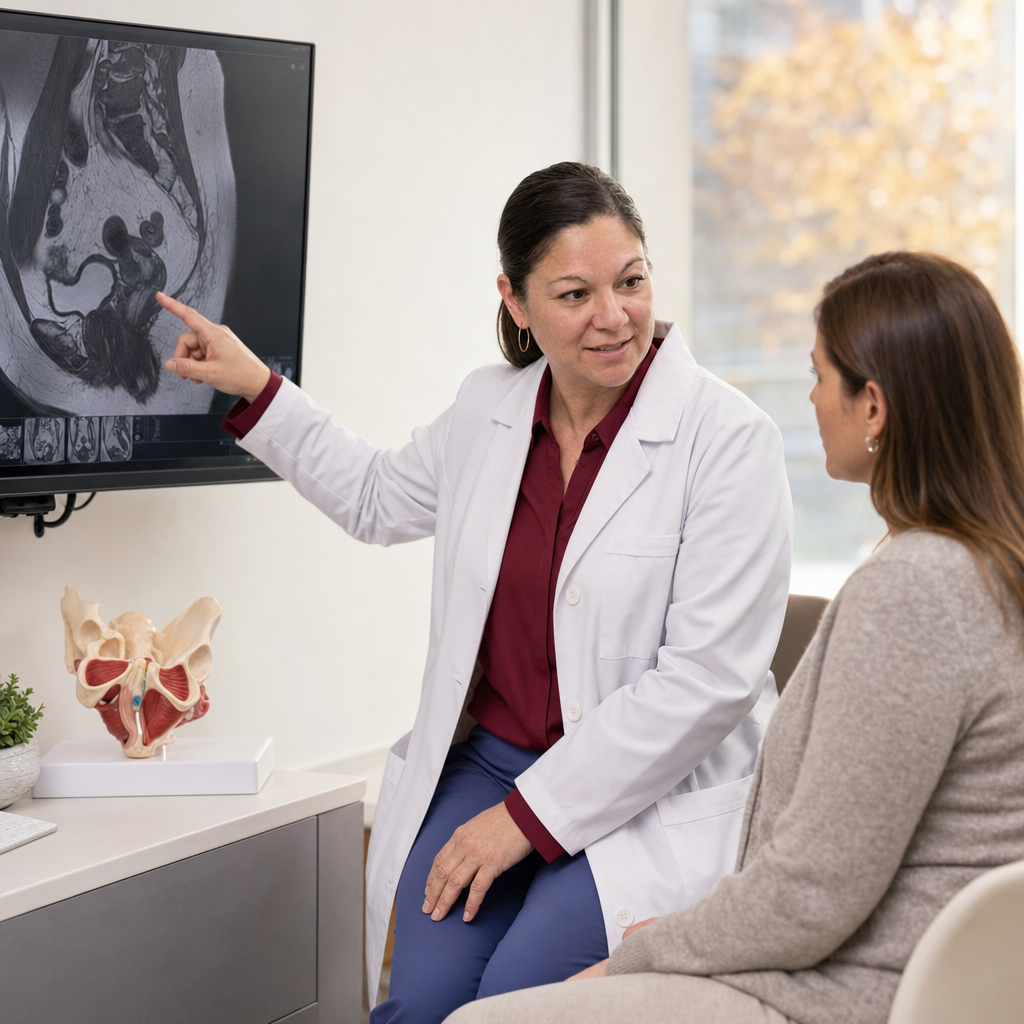
Most patients tell us they assumed the symptom was minor — or just something they would have to live with. Neither is usually true.
Stool or gas escapes without awareness. Often related to internal sphincter dysfunction or reduced rectal sensation.
You feel the urge but cannot make it in time. Frequently associated with weakened external sphincter function or reduced rectal capacity.
Underlying contributors — constipation, overflow, diet, or pelvic floor coordination — masquerading as straightforward incontinence. Identifying the actual driver is half the treatment.
Treatment Approach
Most patients with fecal incontinence improve significantly with behavioral, physical, and minimally invasive treatments — long before surgery enters the conversation. Here is the full toolbox, in the order we typically work through it.
Surgery is one tool in a much larger toolbox. When we do recommend a procedure, it is because we have a specific reason — and we will explain exactly what it does, what it doesn't do, and what recovery actually looks like.
What to Expect
A comprehensive first evaluation with Dr. Johnson. Time to be listened to. In-office diagnostics when possible.
Dr. Johnson has read your intake before you walk in. The conversation starts with the impact on your life — not the textbook.
Performed with explanation at every step. Nothing happens without your full awareness and consent.
Diagnostics are performed in-office where possible to avoid extra appointments.
Every option explained. Pros, cons, and what each one would mean for your week, your work, and your life.
A Patient Story
I had stopped flying. I had stopped going to my grandkids' games. I had not told my husband. Six months after my first visit, I was back on a plane and back at the field. I should have come ten years ago.
— P.J., treated for fecal incontinence after obstetric injury
Frequently Asked
Yes — and the data on this is unambiguous. The vast majority of patients improve significantly with a structured plan, and many reach full continence. The reason patients don't know this is that fecal incontinence is rarely discussed openly with primary care or general OB/GYN providers. A fellowship-trained pelvic health specialist sees this every week.
— Lisa L. Johnson, M.D., F.A.C.O.G., U.R.P.S.
The most important diagnostic is the conversation. After that, a targeted physical examination, anorectal manometry to measure sphincter function, and sometimes endoanal ultrasound to assess sphincter integrity. We perform these in our office whenever possible — no separate appointments, no separate facility.
— Lisa L. Johnson, M.D., F.A.C.O.G., U.R.P.S.
The honest answer is: we test it before we commit to it. The temporary lead trial — about a week — tells us whether the device will give you the result you want. The majority of patients who pass the trial go on to long-term success with the implant. Patients who don't respond to the trial don't get one — which is the entire point of trialing it.
— Lisa L. Johnson, M.D., F.A.C.O.G., U.R.P.S.
Aging is a contributor, not the explanation. The conditions that cause fecal incontinence — sphincter injury, neurologic changes, pelvic floor dysfunction — can all be evaluated and treated regardless of age. I have patients in their 80s who got significant improvement from straightforward interventions.
— Lisa L. Johnson, M.D., F.A.C.O.G., U.R.P.S.
If you'd like them to, yes. I send a written summary of every visit back to the referring provider — that is a standing commitment to every practice that refers to us. The vast majority of fecal incontinence patients are also being seen by a primary care or GI physician, and coordinated care matters.
— Lisa L. Johnson, M.D., F.A.C.O.G., U.R.P.S.
A thorough, unhurried evaluation with Dr. Johnson. You will leave with a written plan — and clarity on what fecal incontinence is doing in your body, and what to do about it.