

Oak Lawn · Oak Brook · Orland Park
For women

Hemorrhoid treatment for women: pregnancy, postpartum and beyond.

Pelvic floor, bladder, bowel — and hemorrhoids — treated together, under one physician relationship. No sedation. Covered by insurance.

“Hemorrhoids are among the most common anorectal conditions in women — and among the most undertreated, because patients assume treatment means surgery. It does not. I have helped hundreds of women avoid the operating room entirely.”

When hemorrhoids occur in women

Pregnancy, postpartum, and beyond.

During pregnancy

Why pregnancy triggers hemorrhoids

Increased blood volume, pressure from the growing uterus, and constipation combine to engorge the hemorrhoidal vessels. Many women first develop hemorrhoids in the second or third trimester. Rubber band ligation is generally deferred until after delivery; during pregnancy, the focus is on symptom management, dietary adjustment, and topical relief. We will evaluate you and prepare a postpartum treatment plan so nothing waits longer than it needs to.

Postpartum

The most common window for treatment

Vaginal delivery, especially prolonged pushing, markedly worsens hemorrhoids. Many women who had mild hemorrhoids before delivery have Grade II or Grade III hemorrhoids afterward. Banding is typically appropriate once healing is sufficient — often at or around the postpartum visit. We will assess the tissue and give you a specific timeline. The procedure is the same: in-office, no sedation, drive yourself home.

Perimenopause & beyond

A second common peak

Hormonal changes affect connective tissue throughout the pelvis, including the tissue that supports the hemorrhoidal cushions. Women in their forties and fifties frequently present with hemorrhoids that have been gradually worsening for years and have never been properly evaluated. This is a straightforward case for banding and has nothing to do with childbirth history.

At any stage

Hemorrhoids that have simply grown worse

Not all hemorrhoids are pregnancy-related. Straining, chronic constipation, prolonged sitting, and family history are risk factors at any age. If you have been managing symptoms on your own — with creams, dietary changes, or simply living with it — a consultation will tell you clearly what your treatment options are and what the expected outcome of each is.

The connection most practices miss

Hemorrhoids and the pelvic floor.

Why they co-occur

The pelvic floor supports the bladder, uterus, rectum and anus as a single anatomical unit. Pelvic floor dysfunction — whether from childbirth, surgery, or connective tissue changes — affects all of these structures. Hemorrhoids, urinary leakage, and prolapse often appear together, particularly in women who have had vaginal deliveries. Treating one without evaluating the others is a missed opportunity.

One physician, one plan

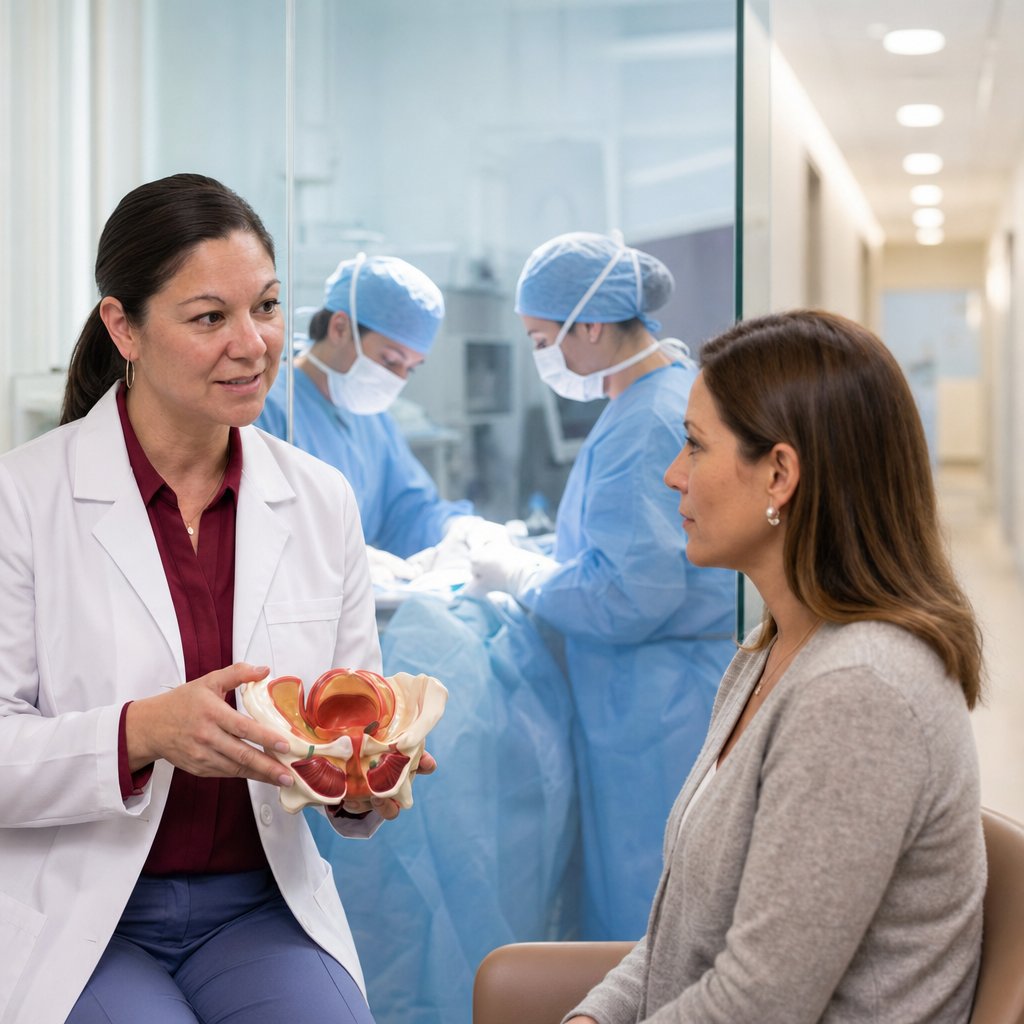
Dr. Johnson is a fellowship-trained urogynecologist. Her training covers the pelvic floor, bladder, urethra, vagina, uterus, and anorectal structures as a connected system. If you have hemorrhoids and also experience leakage, urgency, or a sense of pelvic pressure, you can address all of it in a single evaluation rather than building a separate referral chain for each symptom.

When conservative treatment is the right start

Not every patient needs a procedure. Dietary changes, fiber supplementation, sitz baths, and stool softeners resolve mild internal hemorrhoids in many cases. If conservative management is the right starting point for you, we will tell you exactly what to do and when to return for re-evaluation. Surgery-last is not a slogan. It is how this practice runs.

When banding is the right answer

Grade II and Grade III internal hemorrhoids that have failed or are unlikely to respond to conservative management are the standard indication for banding. The procedure is quick, requires no preparation, and does not interrupt normal activity. Most patients treated at PHII avoid surgical hemorrhoidectomy entirely. The banding page covers the procedure in detail.

Read more: The hemorrhoid-pelvic floor connection explained →

Dr. Lisa L. Johnson, M.D., F.A.C.O.G., U.R.P.S.

Your physician

Lisa L. Johnson, M.D.

F.A.C.O.G.  ·  U.R.P.S.  ·  Board Certified OB/GYN & Urogynecology

Dr. Johnson founded PHII to consolidate pelvic floor care — urogynecology, anorectal care, and pelvic floor physical therapy — under one practice. Women who are looking for a physician who treats the pelvic floor, bladder and bowel together, surgery last, will find that approach here.

Women who are looking for a holistic gynecologist — one physician who treats the pelvic floor, bladder and bowel together — will find that approach on this page.

Full biography and credentials →

If you have rectal bleeding

Rectal bleeding is usually caused by hemorrhoids — but it is also the most important early warning sign of colorectal cancer, and it should always be evaluated. Most bleeding is benign. Some is not. We will tell you which category you are in, and if a screening colonoscopy is overdue, we will help coordinate it.

Bright-red bleeding, pain with bowel movements, a lump, or symptoms that have changed or worsened: call us. Same-day triage is available. (708) 499-9800

Questions women ask most often.
Can I be treated while I'm pregnant?

Rubber band ligation is generally deferred until after delivery, when the tissue has normalized. During pregnancy, the focus is on managing symptoms: fiber, hydration, sitz baths, stool softeners, and topical relief. We will evaluate you, make sure nothing is being missed, and have a clear postpartum treatment plan ready so you know exactly what comes next.

— Lisa L. Johnson, M.D., F.A.C.O.G., U.R.P.S.

How long after delivery can I be treated?

Most patients are candidates for banding once postpartum healing is sufficient — often at or around the six-week check. We will assess the tissue and give you a specific timeline at that visit. Many postpartum patients are treated within two to three months of delivery.

— Lisa L. Johnson, M.D., F.A.C.O.G., U.R.P.S.

Can the same physician treat my pelvic floor and my hemorrhoids?

Yes. That is precisely the structure of this practice. If you have hemorrhoids and also experience bladder leakage, pelvic pressure, or urgency, a single evaluation with Dr. Johnson can address all of it. You will not be referred out for the anorectal portion of your care. Everything is evaluated together, and the treatment plan reflects the whole picture.

— Lisa L. Johnson, M.D., F.A.C.O.G., U.R.P.S.

Will I need sedation?

No. The in-office evaluation and banding procedure require no sedation and no anesthesia. You are awake throughout, in a normal clinical conversation. You can drive yourself to and from the appointment. This is the detail patients are consistently most relieved to hear.

— Lisa L. Johnson, M.D., F.A.C.O.G., U.R.P.S.

Will my insurance cover this?

For nearly all major medical plans, yes. Hemorrhoid treatment is a medical procedure and is covered as such. Our team verifies your specific coverage before your first visit and gives you an estimate of any out-of-pocket cost in advance.

— Lisa L. Johnson, M.D., F.A.C.O.G., U.R.P.S.

I've had hemorrhoids for years and just lived with them. Is it too late?

No. Long-standing hemorrhoids are among the most common presentations we see. The evaluation tells you exactly what grade you have, what treatment options apply, and what the expected outcome of each is. Waiting does not improve the prognosis, but it rarely makes treatment impossible. Come in, and we will give you a clear picture.

— Lisa L. Johnson, M.D., F.A.C.O.G., U.R.P.S.

Restore comfort. Reclaim your life.

The whole picture, one physician.

Pelvic floor, bladder, bowel, hemorrhoids — evaluated together at Oak Lawn, Oak Brook or Orland Park. No sedation. Drive yourself. Most major insurance plans accepted.